Context
Bailarte Limited is a Latin dance academy teaching salsa and bachata. Like a lot of owner-run businesses, it started online the fast, free way: a basic DIY site built on SumUp’s website and shop tools, with the shop bolted to the front. It worked well enough to get going, but it was built around the constraints of a free tool, not around the academy’s brand or how it actually wanted to sell.
The stakes
For a class-based academy, the website has two jobs: present a brand people want to join, and sell courses without friction. SumUp’s free tools capped both. The site looked like the template it was, not like Bailarte, a real problem in a scene where energy and identity are the whole draw. And it was rigid: the owner couldn’t freely shape pages, had no real SEO control to be found by new students searching locally, and hesitated to change anything for fear of breaking the shop. The academy had outgrown its own website, and the tooling was quietly holding back both marketing and sales.
What we found
- Constrained presentation: a template-bound SumUp site that couldn’t be shaped to the academy’s brand. The free tool’s limits, not the owner’s vision, decided how it looked.
- No SEO control: none of the levers that make a local business discoverable, so the academy was harder to find than it should have been.
- Fear of change: with the shop wired into a basic editor, the owner was reluctant to touch the site at all, so it stayed static and out of date.
Ownership & control
What a business owner actually loses when their site and shop live inside free, rented tools:
- Marketing and sales locked inside SumUp’s free website and shop tools: a rented platform the academy didn’t own or control.
- No real SEO control: no say over meta, structure, or how pages were indexed, capping how discoverable the academy could be.
- A fixed, template-bound site the owner couldn’t shape to the brand, its presentation constrained by what the free tools allowed.
- Content changes gated by a basic editor, leaving the owner reluctant to touch the site for fear of breaking the shop.
What we built
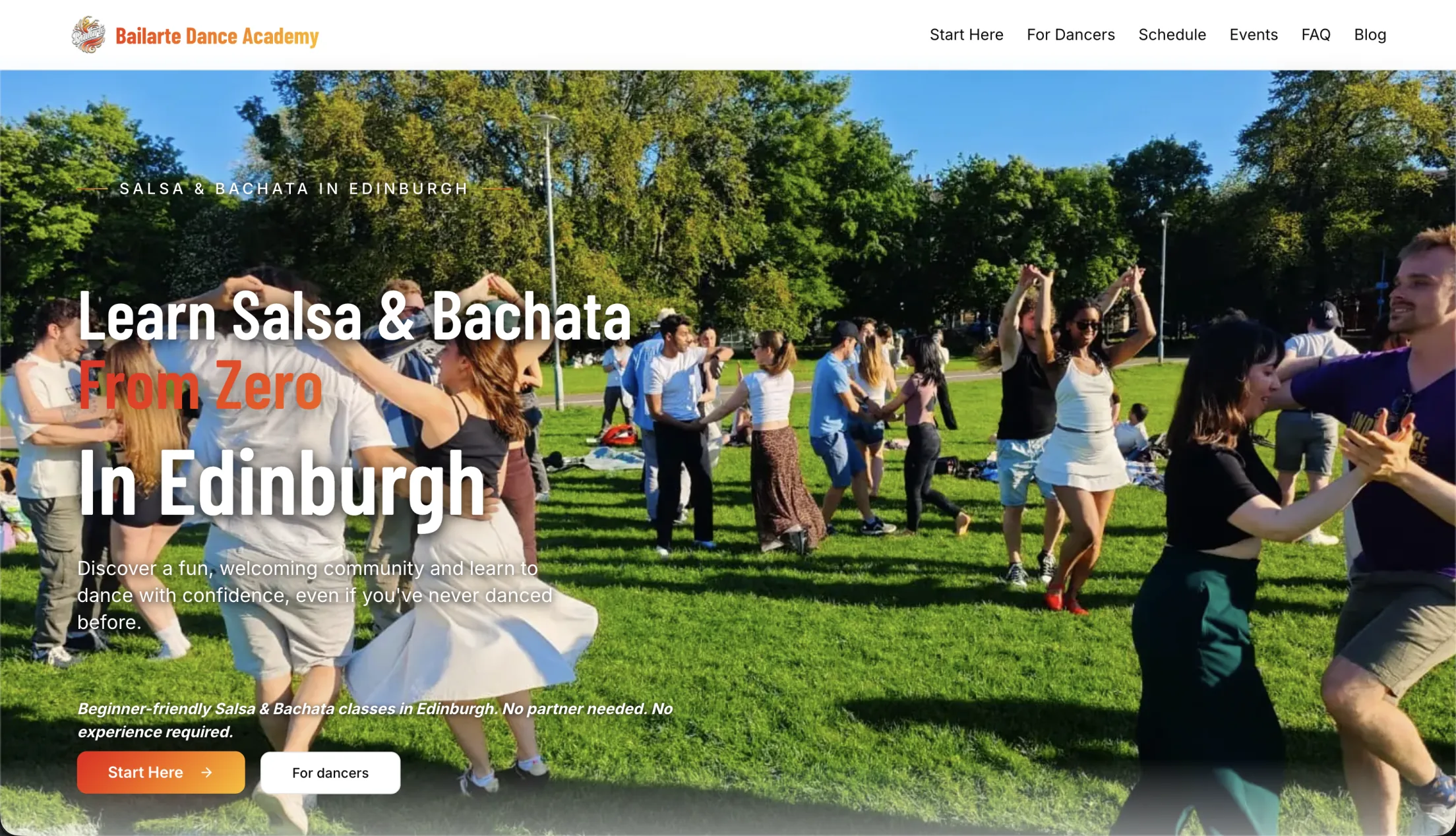
The engagement started with one of our launch services and grew into a full rebuild. We created a new brand and styleguide for the academy, then designed a set of reusable building blocks so the owner can compose new pages from approved, on-brand components instead of fighting a template.
The site itself is built on Next.js + Payload CMS, with the academy’s ecommerce integrated so in-person courses sell directly through the owned site. Content lives in Payload, so the owner edits any page himself, safely and with no risk of breaking the shop, and the platform gives him the full SEO control the SumUp site never did.
The rebuild also fixed the fundamentals the free tools left middling. On mobile, SEO went from 65 to a perfect 100, performance from 63 to 93, and best-practices from 67 to 100: the difference between a site that scrapes by and one built to be found and to convert.
The outcome
Bailarte moved from a constrained, rented SumUp setup to a platform he owns and controls. He can create and edit any page in the site without fear of breaking it, sells courses through integrated ecommerce, and finally has full SEO control: the discoverability lever the old tools simply didn’t offer, now reflected in a perfect 100 SEO score. The site now looks like the academy it represents, not the free template it started on.
As a side note worth reading as a market signal: within about a month of Bailarte’s new site going live, their closest competitor refreshed their own site too. We can’t claim cause and effect, but it’s the kind of thing that happens when you visibly raise the bar in a small, competitive niche.
What this means for you
If you’re an owner-run business that started on free website-and-shop tools and has outgrown them, the constraint isn’t your ambition, it’s the platform. Moving to an owned site gives you a brand you control, pages you can change without fear, real SEO to be found by new customers, and ecommerce that fits how you actually sell. You stop working around a free tool’s limits and start running a site that works for the business.